
OEM Jewelry Development: Fees, Files and Approvals
Most late custom jewelry projects are delayed by paperwork rather than by metalwork: a model that cannot be tooled, an approval given by someone without authority, or a mould whose ownership was never written down. TTT Jewelry answers the three problems with documents — under 48 hours for CAD, 25–30 days for the master, 21–28 days for bulk — and backs the file set with a 100% NDA.

Key takeaways
- A CAD model is only useful if it is manifold, scaled in millimetres and matched to a stated metal.
- Sampling consumes 720 hours at the top of the range; CAD consumes 48, or 6.7% of it.
- One named approver per gate prevents the most common rework trigger.
- Tooling, sampling, plating set-up and freight should be itemised, never bundled into one figure.
Where briefs stall, and the file set that prevents it
Ask a factory planner what causes a missed sample date and the answer is rarely a machine. It is a file that arrives as a photograph, a dimension expressed in gauge when the bench works in millimetres, or a buyer who approves a change verbally and then disputes it three weeks later.
None of these are design failures. They are information failures, and they cost the same bench days as a genuine production problem. An OEM/ODM flow that documents its gates, as an ISO 9001:2015 system requires, makes each one visible before it becomes a delay.
The fix is unglamorous: a standard file set at inquiry, a defined return at CAD, and a signature at every handover. Each of the three is cheap to set up and expensive to skip. A workable inquiry carries five things. First, geometry: a STEP, STL or 3DM file, or a dimensioned drawing with tolerances. Second, metal: 925 sterling silver, artisan eco-brass or 316L stainless, because wall thickness and stone seats are chosen around the material. Third, finish: polished, brushed, textured or a combination, plus the plating colour and karat.
Fourth, stones: size in millimetres, shape, count and setting style, with a note on whether they are natural, CZ or freshwater pearl. Fifth, packaging and marking: whether the piece needs laser engraving, a hallmark such as S925 or 316L, a logo tag, a backing card or a foil-stamped box.
A sketch can start a conversation but cannot start a mould. Factories that quote from a sketch are quoting a guess, and the guess usually surfaces as a change order during sampling.
What the two-day CAD stage returns
3D modelling is published at under 48 hours. What comes back should be a manufacturable model, not a render: closed surfaces, minimum wall thickness for the chosen metal, sprue or gate position for casting, and stone seats sized to the actual stones.
Ask for the file in a neutral format as well as the native one. A brand that holds only a screenshot has no asset; a brand that holds STEP and the original CAD can take the design to another supplier or reorder in three years without redrawing it.
The stage is quick by design. Two days of modelling against a 25-day sample window is 48/600 = 8%; against 30 days it is 48/720 = 6.7%. Almost all of the wait is physical, which is why arguing about CAD speed is usually a distraction from the approval queue behind it.
Approvals: one name and one version
Every gate needs a single approver with the authority to stop the project. Committees can review, but one person signs. When three people can each approve, the factory receives three sets of comments and the last one wins by accident.
Version control is the second half. Label the CAD file, the master photo and the packing proof with the same revision number, and record which revision was signed. A change requested after sign-off should reopen the gate formally, with its own date, rather than arriving as a message that says "small tweak".
The practical test: could a new project manager join in six months and reconstruct, from documents alone, exactly what was approved and when? If not, the approval trail is decorative.
Fees, ownership and the reorder
Custom development is not one price. A quote normally separates tooling or mould cost, sampling cost, plating set-up, packaging tooling or printing, and freight. Some programmes credit the sampling fee against a bulk order; others do not. The structure matters more than the total, because it shows what is charged again on a reorder.
Three questions expose the structure quickly. Is the mould charged once or per revision? Does a second colourway need a new plating set-up? Is the sampling fee absorbed if the order proceeds? A supplier that answers all three in writing is easier to budget against than one that quotes a single development figure.
Tooling ownership belongs in the same conversation. A brand paying for a mould should know whether the tool stays with the factory, whether it can be moved, and what happens to it if the relationship ends. A custom jewelry ODM solutions arrangement with a documented handover is worth more than a marginally lower development quote with none.
The contract carries as much weight as the quote. TTT Jewelry publishes a 100% NDA and states that designs remain exclusive to the brand: moulds, CAD and the collection are not resold or shown to other buyers. For a brand whose product is the differentiator, that clause is the commercial core of the contract, not boilerplate.
Read it against the delivery list. Exclusivity means nothing if the factory keeps the right to reuse a modified version, so the wording should cover derivatives as well as the exact design. Ask where the CAD lives, who can open it and what happens to the physical master after the run.
Ownership also shapes the reorder. A brand that owns the file set can move production, price the next run competitively and survive a supplier change. A brand that owns only finished goods starts from zero each time.
The documents that hold a schedule together
| Document | Produced by | Stage | What it settles |
|---|---|---|---|
| Dimensioned brief and CAD file | Brand | Inquiry | Geometry, metal, tolerance |
| 3D model and tooling review | Factory | Under 48 hours | Manufacturability, wall thickness, gates |
| Master sample and spec sheet | Factory | 25–30 days | Finish, plate, setting, inspection criteria |
| Signed approval record | Brand | Gate | Authority, revision number, date |
| Final QC report | Factory | 21–28 days | 100% inspection evidence before dispatch |
Four of the five rows are documents rather than objects, which is the point. The metal moves only when the paperwork permits it.
Worked example
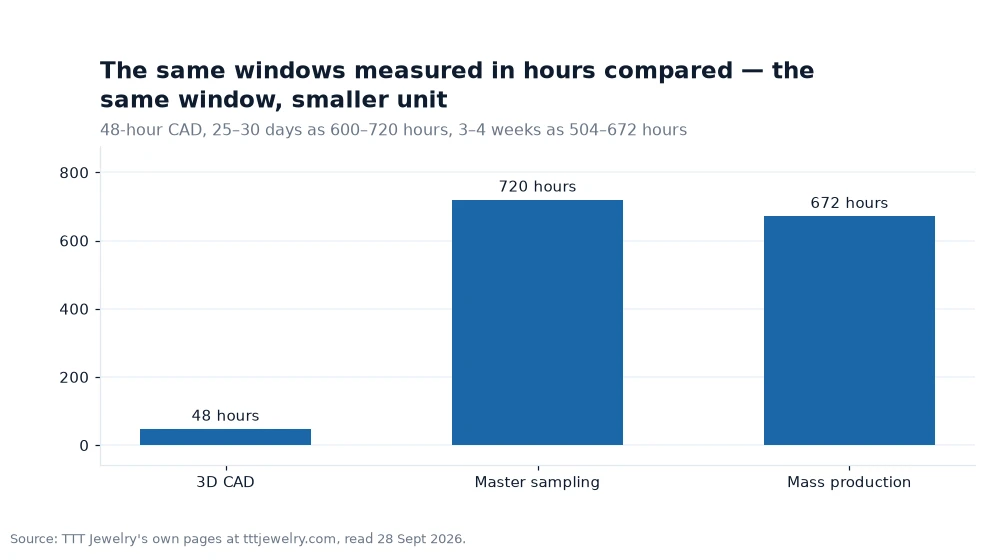
Convert the three published windows into hours and the proportions become obvious. CAD is 48 hours. Sampling at 30 days is 30 × 24 = 720 hours. Production at 28 days is 28 × 24 = 672 hours.
The total is 48 + 720 + 672 = 1,440 hours, which is 60 days, or 8.6 weeks. CAD is 48/1,440 = 3.3% of the programme and 48/720 = 6.7% of the sampling window alone.
Now price the delay caused by a missing file. A brief that arrives as a photograph needs a modelling round before CAD begins. If that round takes five days, the programme moves from 60 days to 65 and every downstream gate shifts with it. The same five days spent on a revision after approval costs a mould adjustment as well.
Two extra designs do not double the calendar, because they pass through the same sampling block. Two extra metals do change the quantity plan, since the silver floor of 50 pieces per design is 50% of the brass floor of 100.
Frequently asked questions
What files should a brand send with a custom jewelry inquiry?
Send a STEP, STL or 3DM file or a dimensioned drawing, the chosen metal, the finish and plating specification, stone sizes and setting style, and any logo, hallmark or packaging requirements. A sketch alone cannot be tooled.
Are development fees included in the unit price?
Not usually. Tooling, sampling, plating set-up, packaging and freight are normally quoted as separate lines, and some programmes credit sampling against a bulk order. Ask which charges recur on a reorder.
Who owns the mould and the CAD file?
Ownership is set by contract, not by practice. TTT Jewelry states that moulds, CAD and the collection stay exclusive to the brand and are not resold, so the agreement should confirm file custody and what happens if production moves.
Setting the paperwork before the metal
A development folder assembled in week one — brief, files, approver names, fee schedule, ownership clause — removes most of the reasons a sample date slips. It also makes the second order far cheaper than the first, because the file set already exists.
Brands building a range rather than a single piece should brief a stainless steel jewelry manufacturer at the same time, since 316L takes PVD plating and a different set of finish references from silver.
Where volume is the priority, a sterling silver jewelry manufacturer working at 50 pieces per design gives the widest room to test before tooling is duplicated across metals.
The sequence holds whatever the product: agree the documents, approve the objects, then spend on the metal.
Source note: figures come from the manufacturer's own website (tttjewelry.com), read 28 Sept 2026.[1]